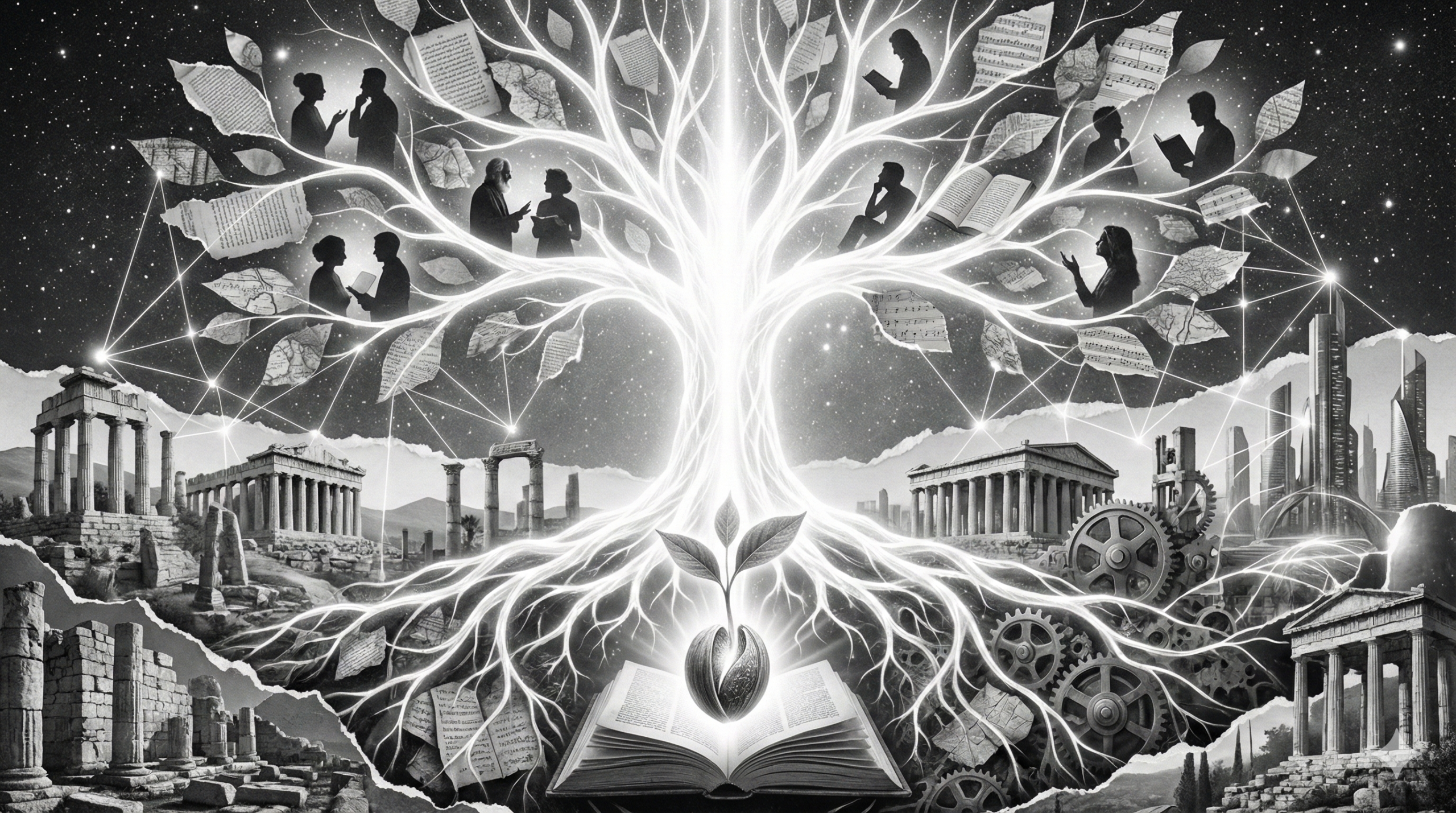
“Nozomi” (Hope) — Vision
A Framework for Mental Infrastructure Transcending Time and Space
This vision is not a list of numerical targets or schedules.
It is a path of hope toward the future, tracing how the seed of a “story” sprouts, becomes a forest, and eventually forms the foundation of a civilization.
Yet this is not a finished map.
Even the author does not know its final shape.
The seed of a “story” sprouts in unexpected places, bends, withers,
and yet, elsewhere, takes root again.
This vision looks upon that very process from afar.
I define this creation not merely as content,
but as a living mental infrastructure project, meant to endure for thousands of years.
Mental infrastructure is an invisible yet essential foundation—
one that allows people to question the meaning of life for themselves,
and to re-understand the world in their own words.
What follows is a story told from the future,
looking back on how this infrastructure came to be,
through the lives and hands of people.
Vision | The Story of an Unfinished Forest
It began with a single, small story.
A serialized novel written by someone, somewhere, without a name.
It was neither a book of philosophy nor a work of theory.
It was a story written not to teach answers,
but to leave a question quietly inside the reader.
The story continued to be released, quietly.
Without rushing for reactions.
Without seeking praise.
It was simply written, spoken, and left there.
After a few years had passed,
invisible changes began to appear in those who encountered it.
Some began to write their impressions.
Some layered their own lives and memories onto the story.
Some, inspired by it, began to write new stories of their own.
In time, it was no longer the creation of a single person.
The story became plural—
shared as text, video, sound, dialogue, and even silence.
There was no clear organization.
No leader.
There was only a shared stance:
To continue questioning what it means to be human,
in one’s own words.
Time passed.
The person who had written the first story gradually faded from the foreground.
Yet the creation did not stop.
The story was never fixed.
It never became a canon.
It was rewritten, broken apart,
and transformed into the seeds of other stories.
One hundred years later,
few remained who knew the full text of the original work.
And yet, something endured.
Do not rush the question.
Do not aim for completion.
Trust your own senses and your own words.
That attitude, unmistakably, was still alive.
Five hundred years later,
it could no longer even be called a culture.
And yet, as a quiet and definite practice,
it had taken root in many places.
One thousand years later,
it was no longer possible to identify who had begun it.
Still, people understood.
This was not an ideology.
Not a theory.
Not a heritage.
It was a living tree—
born again and again
from humanity’s effort to remain human.
Five thousand years later,
that tree, with countless branches,
breaking, intertwining, regenerating,
stood quietly at the feet of many civilizations.
Over time, what had once been called “mental infrastructure”
had become a rich forest—
not grown through plans or systems,
but through the lived experience of people.
There was no single correct path.
No central axis.
In every era, each individual entered the forest from their own place,
and looked up at their own sky.
It was never completed.
There was no need for it to be.
This creation was not an attempt to leave a single answer for the future.
It was an ongoing effort
to keep laying the mental infrastructure
that allows people, in every age,
to live their own questions.
A Separate Chapter | Memories from When There Were Only Seed and Soil
This vast chain was never intended from the beginning.
Yet in the earliest years, there were several clear practices.
1. Stories as devices for questioning
The first step was not to present completed works,
but to continually publish serialized stories designed to awaken thought.
Judgments of good and evil were deliberately avoided.
Spaces were left open,
so readers could layer their own experiences and emotions onto the narrative.
2. Multilayered expression through image and sound
The story did not remain as text alone.
It was re-shaped into video, audio, and spoken narration,
reaching inward through multiple sensory pathways.
This was not meant to promote “understanding,”
but to unsettle perception and thought at the same time.
3. Creating places where resonance could gather
Spaces were prepared where those touched by the work
could safely place their impressions and questions.
There, how one felt and what one thought
mattered more than evaluation or hierarchy.
Over time, these spaces expanded—
into gatherings in the physical world,
and into shared places within digital realms.
4. Welcoming creators who surpassed the author
It was never the aim for the author to remain at the center.
What was desired was the emergence of people
who questioned more deeply,
who wove richer stories,
and who began creations of their own.
The first five years were nothing more than the preparation of soil.