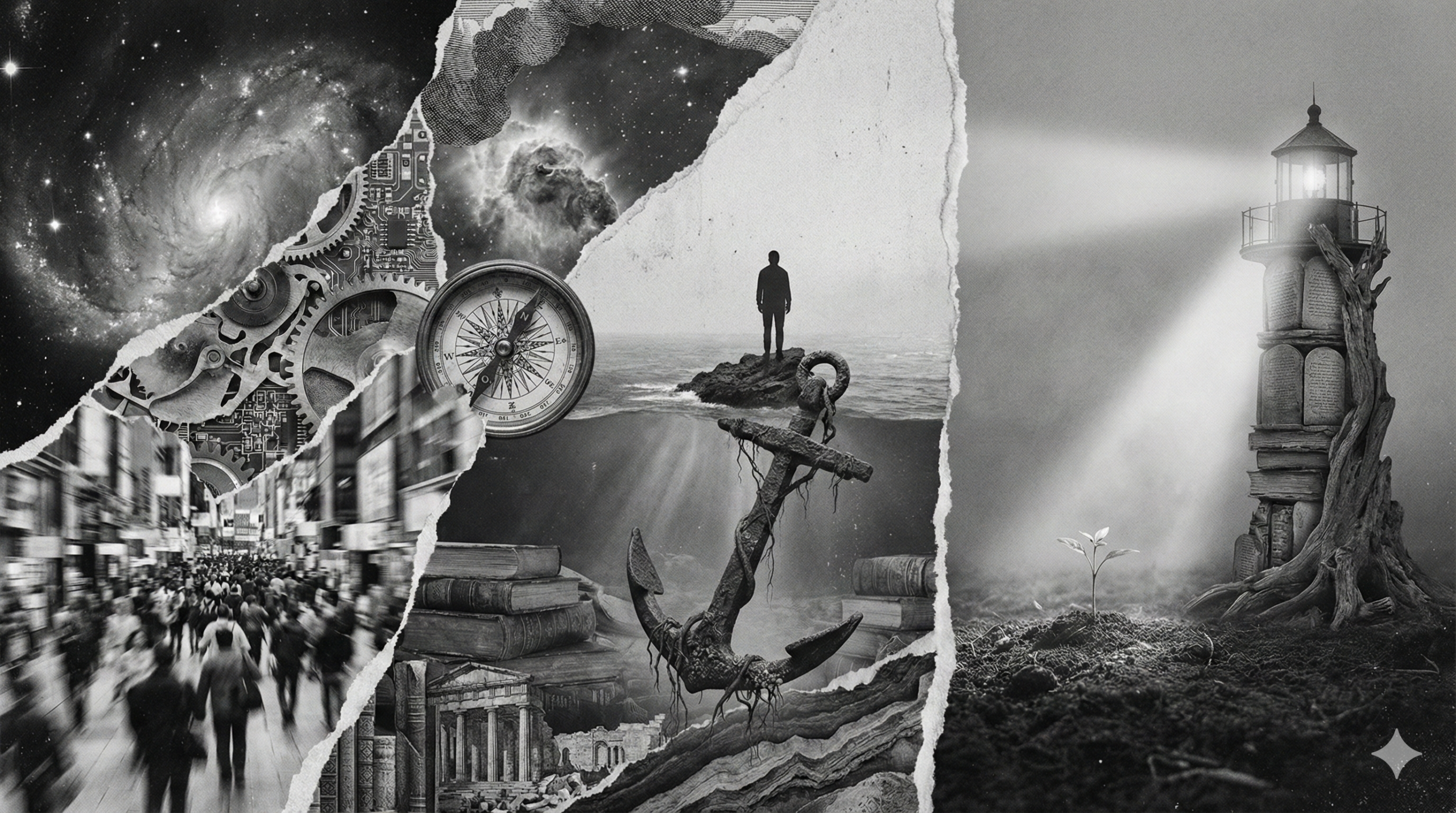
The purpose of persophy
This purpose is not a slogan for success or self-improvement.
Nor is it a claim of moral correctness aimed at fixing society.
The reason persophy exists is simple, and demanding:
to continue offering, as an open question, what it means for a human being to live as an individual.
People are not saved by being given answers.
A sense of being alive can only be reached by thinking for oneself, choosing for oneself, and bearing the weight of those choices.
persophy does not prepare answers for that journey.
Instead, it creates the conditions in which thought can arise, and a place strong enough to endure unanswered questions.
This is not enlightenment.
It is not guidance.
It is a quiet call, addressed to a single human being.
1. A Macroscopic Perspective: Eternal Time and Ephemeral Lives
A cosmic view and the realism of the individual
The universe is said to have begun 13.8 billion years ago.
Life emerged on the planet Earth around 3.5 billion years ago.
After an almost unimaginable span of time, Homo sapiens appeared only 400,000 years ago, and around 50,000 years ago, a radical transformation of cognition ignited an explosive evolution of intelligence.
Yet even this grand drama of evolution is less than a blink of an eye on the scale of the cosmos.
The neighboring Andromeda galaxy lies 2.5 million light-years away.
Before such vastness of space and time, the entirety of human history is no more than a grain of sand—let alone the noise of human society, or the lifetime of a single individual, which registers as a fluctuation too small to be observed.
From the perspective of cosmic law, a human life is a fleeting moment, nearly indistinguishable from nothingness.
And yet, here lies an irrational realism.
That small and brief life—almost nothing to the universe—is, for the one who lives it, a world equal to the entire cosmos.
No matter how insignificant it may appear, a person’s world exists nowhere but within that person’s own self.
Absolute minuteness, and the infinite weight of subjective experience.
Bearing this unbearable contradiction, how are we to kindle meaning within such a short life?
When this question is brought down to a single point called “the present,” it becomes even more urgent.
2. Contemporary Society: Optimized Functions and a Lost Compass
A phenomenon of modern society.
Lowering our gaze from eternity to the present moment, we find a civilization of unprecedented development, safety, and comfort.
And yet, beneath this prosperity, a subtle transformation of the human spirit is quietly unfolding.
The blade called rationality shaves away the natural thickness of human existence, soundlessly, into thin slices.
Utilitarian thinking—measuring everything by profit and loss—turns even relationships and child-rearing into matters of cost-performance, eliminating inefficient emotions and silence.
Standards of right and wrong are outsourced from inner morality and aesthetics to external laws and systems.
People judge good and evil by relying on systems, having lost their own compass.
Unarticulated nuances are treated as if they do not exist.
Only numerical outcomes remain as proof of value, while the stories embedded in process are discarded.
The most dangerous phenomenon, however, is the absence of the self.
External evaluations erode the inner core, hollowing it out unnoticed.
It is as if people are voluntarily turning themselves into optimized components.
There is no intense despair here—but there is no hope either.
What remains is a thin, quiet nihilism that laughs and says meaning is unnecessary.
It is not despair.
But the very capacity to desire hope has already been worn down.
In a world where everything is rationally explained and efficiently optimized,
why do we remain so unfulfilled, so persistently unable to grasp the outline of ourselves?
The answer lies deeper.
3. The Core Problem: Exhausted Inner Soil and the Loss of Reference Points
The essence of the problem.
These phenomena are not simply matters of changing times or individual attitudes.
The mechanization of labor and time brought by the Industrial Revolution, and the automation of thought brought by the Information Revolution—at the end of this historical chain, humanity is structurally losing something decisive.
That loss is a universal anchor—something that once held the individual steady amid rough seas.
Human beings once carried a weight and a mirror within themselves.
By reflecting themselves in the vertical mirror of history and myth, and grounding themselves in cultivated sensibility and aesthetic judgment, they maintained an inner self that could withstand external storms.
But the accelerating systems of modern society severed this inner anchor as unnecessary.
As a result, two fatal transformations have taken place within the structure of the human psyche.
The first is the externalization of judgment.
The laborious circuit of questioning one’s own conscience and aesthetics has been shut down.
In its place, algorithmic recommendations, quantified evaluations, and legal frameworks become the sole standards of correctness.
Once people abandon their own compass and entrust navigation to external systems, they cease to be autonomous beings.
The second is the hollowing out of process.
The pain of cultivation—the slow work of tilling soil and nurturing seeds—is discarded as inefficiency.
In a world that demands immediate results, the thickness of experience, the value of silence, and inexpressible emotions are erased as unmeasurable noise.
Having lost their anchor, outsourced judgment, and been stripped of depth, human beings increasingly resemble not living organisms, but terminals in a system—entities valued only for their responses.
Thus, the essence of the problem is clear.
We are not anxious by nature.
We have simply left behind, somewhere along the way, the inner harbor to which we could return—and the anchor meant to be dropped there.
4. Rebuilding the Harbor of the Self
Recovering the Lost Anchor.
The inner harbor and the universal anchor that civilization has left behind.
The true aim of this undertaking lies in their reconstruction.
This is not entertainment.
It is a quiet act of infrastructure-building, meant to pass on the foundations of the human spirit into the future.
To achieve this, I seek to recover two lost functions through storytelling.
First, to raise once again a vertical mirror.
13.8 billion years of cosmic history, and 400,000 years of human existence.
Stories that contain this overwhelming depth reinsert an absolute coordinate axis into a present dominated by rationality and speed.
By including children five thousand years from now within its horizon, this perspective nullifies endless horizontal comparison and reconnects human beings to something higher.
Second, to cultivate fertile inner soil.
Silence, subtlety, the pain of becoming, emotions that resist language.
These noises—cut away by the blade of optimization—are gently polished anew by the soft cloth of story.
Refusing to bind questions to easy answers, and allowing them to grow as questions.
This act itself becomes nourishment, restoring richness to an inner landscape turned to desert.
A single human life is no more than a minute fluctuation in the universe.
But if that instant is the entire universe for the one who lives it, then that world needs a harbor to return to.
That is why I weave stories that let sunlight fall upon that harbor.
Just as the wisdom of those before me once lit my way,
I wish to leave embers of philosophy and aesthetics within someone yet to come.
This voyage is driven not by technology or trends, but by the principle of the soul.
Over the short yet long span of five thousand years, this work will continue to erect stone pillars—reference points for thought.
Not conclusions, but pathways of questioning for living deeply, handed forward as a small archive.
Drop the anchor.
The harbor is here.
I quietly vow that this story will become a lighthouse, linking those who resonate today with travelers five thousand years in the future.